
[Excerpt from The Pickett Line November 2025 Issue]
Welcome to a new year for the US truckload freight market and the 6th year of continuous monthly installments of America’s favorite market research publication, The Pickett Line. As many of us use the turn of the calendar as a milestone from which to set new goals or make fresh resolutions for the year ahead, the research and writing team here at Pickett Research is no different. Over the years, you have probably noticed each issue slowly expanding in size as new storylines come into and out of the conversation with shifts in both the economy and the freight market. And in looking back, quite frankly, we’ve probably dragged more than a few of them along for longer than we needed to. So as we enter 2026, we resolve to shed some of that weight and get skinnier – re-indexing for the here and now and what lies just around the corner. And hope that this leaner version proves easier to digest from month to month – and we endeavor to make this transition all without the help of GLP-1s…not that there’s anything wrong with that of course. So with that said, let’s get started.
Looking back on December, and now this first half of January, it’s hard not to channel our inner Ron Burgundy with a “Boy, that escalated quickly.” With the Q4 US Truckload Spot Linehaul Index sitting at +2.9% Y/Y in last month’s October issue, given some of the early December momentum already rippling through the market, we pushed our forecast slightly higher to +4.0-6.0% Y/Y. Now with a final print on the board at +4.6% Y/Y, that’s exactly what we got. We closed a mere 40 bps off of our +5.0% Y/Y forecast and almost dead even with the prior year’s Q4 2025 of +4.8% Y/Y – just before Liberation Day and the launch of the US Trade War that throttled TL demand in Q1 and subsequent quarters. So where do we go from here? How much of December’s +13.1% M/M rise in spot rates can really be attributed to anything more than normal seasonality and retail diesel prices tanking -5.4%? While that continues to be under constant debate among market participants and pundits, we won’t likely get much real signal one way or another until we get into February. For reference though, we got a +4.5% M/M move higher last year in December and +4.4% the year before that. The 15-year average has been +3.0%.
Through the first two weeks of Q1, however, spot linehaul rates have proven to remain stubbornly high for this time of year – with our preliminary Q1 mark currently sitting at +19.8% Y/Y vs. a forecast of +10.0% + 5.0%. While we fully expect rates to fade lower in the coming weeks, we don’t believe we’re headed all the way back to November 2025 levels. Instead, we believe that the market is in the process of setting a new rate breakeven point as marginal supply continues to exit and the floor on driver wages begins to reset higher as a result. Keep in mind that the spot market, based on estimates from the annual ATRI Analysis of the Operational Cost of Trucking, has been unprofitable for the last 12 quarters and while unprecedented over the last decade, that can’t last forever. So what we could be witnessing is the inevitable reckoning, just accelerated by increased regulatory scrutiny around immigration status, non-domiciled CDL compliance, and the English language proficiency of drivers. Should this trajectory hold, and Q1 closes within the forecast range, then we maintain current guidance for spot linehaul rates to rise +20-30% Y/Y by the end of the year – or +10% from current levels. And that’s even without a meaningful demand catalyst to compound on the impact of capacity flight. If we get any version of a recovery in demand at the same time – be it from IEEPA tariffs getting overturned or any version of inventory restocking, a more active housing market, or a rise in domestic manufacturing activity – we could easily see spot rates surge to +30-45% Y/Y, which would be entirely within range of past cycles.
Contract linehaul rates, as measured by the Cass Linehaul Index, closed Q4 at +2.4% Y/Y vs. a forecast of +3.0%. We continue to expect contract rates to march higher over the balance of the year and close somewhere in the neighborhood of +6.0% Y/Y by Q4 as rising spot rates put more and more pressure on contract routing guides starting as early as Q1.
And until we get any resolution on the question of how much of the recent run-up in spot rates was Seasonal or Cyclical, we believe there is no more relevant chart to keep front of mind than last issue’s ‘Chart of the Month’ that we’re highlighting again here. Recall that perhaps the greatest still-unsolved mystery of this freight recession had been in understanding exactly how many carriers have been able to survive for so long with all-in spot market rates running below estimated per-mile operating costs for the longest period since the Great Recession back in 2007-09 – and thus delaying what had up to this point been a relatively predictable spot market rate cycle.
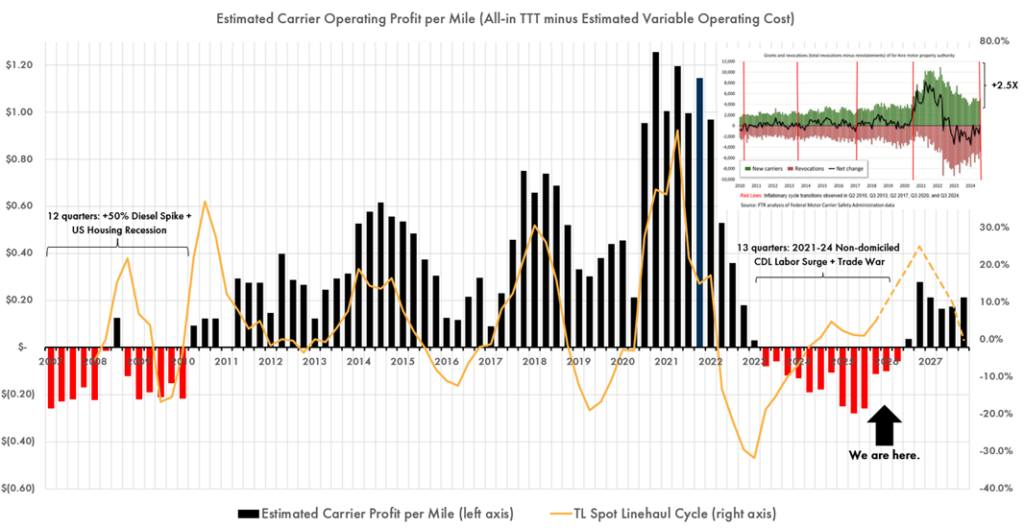
In the chart above, we show the estimated motor carrier operating profit per mile through the US TL Linehaul Spot Rate Cycle going back to 2007. When the bars are in the black, that means that all-in TL spot linehaul rates (including fuel) exceed the average estimated operating cost per mile as reported in ATRI’s annual ‘An Analysis of the Operational Costs of Trucking’ report. And when the bars are in the red, where the market has been going on 12 quarters, those operating costs (which include fuel, driver wages and benefits, lease costs, insurance, tires, tolls, etc.) exceed the national average all-in rate per mile that the spot market is paying.
So for enough of the supply side to sustain operations while the broader market is in the red, something we again haven’t seen in 15 years, that can only mean that there are a bunch of carriers out there with the financial resources to continue operations where every incremental mile is unprofitable – no doubt in an attempt to weather the storm and recover when the market inevitably corrects higher. And there have been a number of theories floated along the way, by Pickett Research and others, to explain how they may have been able to do so – from 3-year truck leases secured prior to lease costs surging higher with interest rates starting in early 2022 to COVID-era Small Business Administration (SBA) loan proceeds splashed around with sweetheart terms. While some or all of those catalysts may have been a factor for many carriers along the way, it seems really hard to believe that they could have impacted the market enough to explain both the conspicuously long duration of the Y/Y deflationary leg of the last rate cycle from 2022-24 and the last four to five quarters of an equally conspicuous flattening of the rate curve at < +5.0% Y/Y. But what if there was a more systemic dynamic in play that evolved right under our noses to explain this? That is exactly what we now propose as we connect the dots between the rise in non-domiciled CDL drivers and the relative market cost of that labor through the cycle.
First, consider that fuel and labor historically account for 60-70% of operating costs for the average US motor carrier – as reported by ATRI based on the carriers that respond to their survey every year. So over two thirds of the operating expenses that compare with all-in spot market rates to form the black or red bars in the featured chart are from these two costs alone. Historically, it had been our understanding that the cost of labor doesn’t change all that much on a year-to-year basis – at least as compared to diesel prices which showed greater levels of volatility over the years and which often had a direct impact on spot market freight rates. So we tended not to focus much on labor costs and assumed that, while there were no doubt differences in those costs based on region or equipment/fleet type, the market as a whole tended to have mostly comparable labor costs on a year-to-year basis. That said, it is widely understood that owner-operators or small fleets where the owners are the ones behind the wheel, tend to have a lot more wage flexibility than larger carriers or private fleets with hired drivers. And that cost structure would allow them to operate at moderately lower freight rates than their larger competitors without going bust – for at least some period of time. And partially as a result of that, the observation has been made that a cohort of carriers clearly still exists that has found a way to operate at $1.50/mile – whether profitably or not.
So how are they doing it? As outlined last month, we now believe the answer is two-fold. One, just the sheer magnitude of the surge in operating authorities granted and therefore new MCs entering the market during the COVID and post-COVID boom years of 2021-24, while a number of larger fleets like Davis Express and now 10 Roads have been forced to exit, suggests that the market has trended towards more fragmentation not less – so relatively more owner-ops and small fleets with more flexible cost structures than in past cycles. But we think the real story could stem from the relative rise in the cohort of non-domiciled Class A CDL drivers through the COVID cycle – accelerated by loose immigration policy and material weaknesses in the CDL examination process itself in states like CA, TX, PA and IL.
And this dynamic is what we now believe could be the smoking gun that explains both the depth and the duration of the current freight recession. Left to its own devices, we believe the market would still grind through its normal Darwinian process of weeding out unprofitable surplus supply over time – albeit at a much slower pace than in the past, something we have all experienced directly over the last two years. Consider that prior to 2015 when many state non-domicile CDL programs were expanded, deflationary market corrections took on average three quarters to move from their deflationary inflection point back to equilibrium. The 2016 recovery took four quarters, which was followed by a 2019 recovery that took five quarters. The 2022-24 recovery took six, before going on to stall out and hover at < +5% Y/Y for another five quarters. So while the foundational battle between supply and demand that governs overall cycle dynamics remains intact, something clearly appears to have evolved that has stretched the duration of our corrections. And we believe that “something” is materially increasing relative labor wage flexibility driven by the increasing level of fragmentation overall, but more so by the increasing proportion of non-domiciled CDL drivers out in the long-tail of owner-op and small fleet capacity.
We make no claims here around the skill, ability, or safety record of the non-domiciled and/or non-EPL compliant CDL population relative to their US-domiciled counterparts. And while it’s hard to argue that non-English speaking or reading drivers don’t pose a potential safety risk to US highways, whether that has proven to be the case over the years is probably unknowable. That said, none of that really matters with regard to this particular argument. The fact that EPL regulations are now being enforced during DOT inspections, the immigration status of Class 8 truck drivers is being screened at highway and facility checkpoints across the country, and non-domiciled CDL programs are being scrutinized, if not shut down altogether, will immediately begin to reverse these driver cohort trends – both by putting more drivers out of service and by making it more difficult if not impossible for new non-domiciled labor to enter the market in the first place going forward. Or in other words, the market will not be left to its own devices in the quarters ahead as spot linehaul rates seek to correct higher. An evolving regulatory landscape is going to pressure the supply-side recalibration by accelerating the exit of what we propose is a cohort of drivers and carriers that, up to this point, have been willing and able to run at materially lower labor rates than the broader market.
And that is the insight that had eluded us over the last year or two as we’ve struggled to understand and explain why it has taken so long for the market to break Y/Y inflationary (and stay there) from its last deflationary inflection point all the way back in Q1 2023. But with market forces, in the form of federal regulatory scrutiny, now in place to accelerate the reversal of this trend, we expect future cycles to look a lot more like those that we observed prior to the most recent COVID and Russia-Ukraine distorted one that we are still trying to break free from. In the meantime, we now understand the extent to which the supply side has evolved over the last twenty years as a result of immigration policy and the ill-advised and ultimately untrue driver shortage narrative. So getting to more accurate and complete data on the segmentation of the estimated 3.5 million Class A CDL truck drivers that comprise the supply side of the market is going to be increasingly important when it comes to forecasting the shape of the rate cycle going forward. We believe we are closer to understanding it now. And we’ll unpack it all in this month’s November 2025 issue of The Pickett Line.
So with Q4 2025 closing mostly on-guidance and a preliminary Q1 2026 at almost double the forecast, what does the current market trajectory mean with regard to expected market behavior? How are buyers and sellers likely to behave? As noted in recent issues and summarized again here for any new subscribers, with the projected spot market cycle well into inflationary territory, many enterprise procurement teams have logically looked to extend the duration of their current contracts to try and ‘keep rates locked in at the bottom’ for as long as they can get away with – which never really works over the long term yet represents a short-term temptation that is often difficult to resist. We estimate that through the duration of the most recent inflationary leg of the rate cycle from Q3 2020 to Q1 2022, TL spot linehaul rates ran at an +18.1% premium (or penalty if you’re on the buy-side) to contract rates – with the first two quarters representing the worst of it at +20-23%. This compares to an average premium/penalty of +10.4% during the last inflationary leg before that (Q2 2017 to Q4 2018), so cycle amplitudes have clearly increased thus amplifying the relative penalty cost of the spot market altogether during this phase of the cycle.
Regardless, we should then look for many contract routing guides to begin springing leaks in the months ahead as primary tender acceptance rates start to fall back towards 2020-21 levels. That said, all is not lost if you are one of those procurement teams that run this playbook, usually under duress from a finance organization or executive leadership team looking to drive operating costs lower by any means necessary – especially as tariffs begin to bite. You’ll just need to be especially agile as the freight market landscape shifts in the quarters ahead. To that end, if you haven’t done so already, we recommend that you invest in the technology and tools required to give your team the visibility and control they need to track the performance of your contract lanes and carrier partners on at least a weekly basis, and then be in a position to take decisive action if necessary – from rebidding lanes away from underperforming vendors to procuring surplus backup capacity at rates likely to be more attractive than what you’ll find in the spot market when you need them, to leveraging more dynamic contracts that adjust more frequently based on market indices or benchmarks.
If you’re unable to position for long-term performance to begin with because global procurement best practices dictate otherwise, the next best thing is to build the operational flexibility to course correct and adapt before your competitors do as the economy and market evolve and the freight cycle marches on. In this regard, if speed is king, pre-planning is queen. The faster that Shippers and Carriers alike can identify meaningful market or network signals, understand their potential implications, and take action, the better they are likely to perform as we navigate these unprecedented times ahead of us.
Now on to the November macro update, where most of our primary indicators are back on their regular reporting cadence after delays from last quarter’s government shutdown. After a string of mostly constructive months, we’re back to the typical mixed bag we saw over most of 2025. Preliminary Q3 2025 Consumption came in at +2.6% Y/Y, in line with the prior quarter’s +2.7% and continuing to hold up in the face of ongoing headwinds for the American Consumer. That said, most of the strength was in Services, which notched 20 bps higher Q/Q to +2.4% Y/Y. Durable Goods consumption decelerated all the way to +3.2% Y/Y from Q2’s +4.9%, representing the weakest print since Q1 2024. Nondurable Goods slowed 20 bps Q/Q to post weaker yet still-respectable +3.0% Y/Y.
Given the relatively higher freight intensity required to satisfy the demand for physical Goods, a sustained recovery in Durable and Nondurable Goods consumption would clearly be a bullish signal for future truckload capacity demand. As finished goods inventory is depleted over time, wholesale replenishment orders get triggered more frequently. If sustained, this drives factory orders higher, which then requires increased levels of industrial activity to fulfill those orders and replenish wholesale and retail inventories to satisfy future demand. And US truckload capacity is likely going to be needed to move those goods through just about every link in that chain – even more so if more of that production happens in North America as opposed to overseas. But with Goods consumption instead mostly slowing over the course of 2025, we see no such signal, and therefore no obvious forward demand catalyst yet in sight for the US freight market.
Now with the protagonist of our story, Consumption, continuing to make its case that US Consumers remain mostly resilient and that ongoing relative weakness in Industrial Production is unlikely to last, let’s check in with our proverbial villain – Industrial Production (IP) itself. While our dramatic yet corny ‘Consumption vs. Industrial Production: Which is telling the truth?’ storyline finally got a jolt in 2025 with IP breaking Y/Y inflationary in Q1 at +0.7% after running flat to -1.0% for nine quarters running, it went on to hit +1.6% Y/Y in Q3 and then closed Q4 higher still at +2.2% Y/Y – now within 40 bps of the Q3 Consumption print. Recall that the entire premise behind the ‘ Consumption vs. IP’ storyline was that these two indicators tended to correlate pretty closely historically. Only in rare cases, usually during an NBER recession, have we seen IP diverge materially from Consumption over the last 35 years. And with the observed recovery in IP over the last year, from -0.9% Y/Y in Q4 2024 to +2.2% Y/Y in Q4 2025, we’ve finally closed one of the longest periods of divergence in chart history, which means we can finally rule in favor of Consumption in this case as it proved once again to be the more reliable indicator for the overall health of the Consumer and the US economy as a whole. So in the spirit of new beginnings and closing out stale storylines, this is one that we can put back on the shelf until the next time such a divergence begins to materialize.
One of the places we’ve also continued to look for more signal is in relative inventory levels, where an accelerating Inventory-to-Sales Ratio is bearish for Industrial Production and a decelerating ratio tends to be bullish. And just like Industrial Production from 2023-2024, this ratio ran dead flat at 1.37-1.38. But unlike Industrial Production through most of the last year, we didn’t get the same bullish signal in the form of a declining ratio value. Instead, we stayed mostly flat at 1.37-1.38. And flat is where we remain with October’s preliminary read for Q4 2025 flashing another ho-hum 1.38.
As we all know by now, the Inventory-to-Sales ratio historically runs inverse to Industrial Production, which makes sense as bloated inventory levels diminish the need to make more stuff to restock shelves. That means once we finally do observe a local top in the inventory-to-sales ratio, we should expect to see a local bottom in IP – and vice versa. So if a downward trajectory is sustained in the quarters ahead, it would represent an increasingly constructive signal for industrial activity, the demand for TL capacity, and the economy as a whole.
So if Industrial Production was really as constructive as its index suggests over Q4 2025, we would expect to see at least some downward drift in relative inventory levels in the November and December revisions. If we don’t get any version of that, then the strength of the industrial recovery remains firmly in question until we do – or we’re able to gain more conviction elsewhere.
With recent Consumption, Industrial Production, and relative inventory levels all starting to show signs of stability if not potential recovery to the upside, let’s turn to our primary TL demand indicators – the Cass Shipments Index and the ATA TL Volume Index. As with relative inventory levels, we saw little to get constructive about in 2025. While perhaps the big story last year was IP finally marching higher on a Y/Y basis to once again converge with Consumption, we got the opposite with TL demand as both indicators continue to diverge to the downside from Industrial Production. The Cass Shipments Index closed Q4 at -7.6% Y/Y, its weakest print in over two years. And the ATA TL Volume index revised Q4 to its lowest print all year at -3.4% Y/Y after closing Q1 at the equilibrium line of 0.0%. But if the implied growth in Industrial Production is to be believed going forward, we will have to see a bounce higher in one or both of these indicators by the middle of this year.
Now let’s shift our attention to the supply side and Net Class 8 US Tractor Orders, which have spent the entirety of 2025 in Y/Y deflationary territory. And with our final revision for Q4 now on the board at -12% Y/Y, deflationary is where we’ll stay. That said, the December print was a monster. It was the strongest net order number going all the way back to October 2022 and pulled the Q4 total all the way up from -33.0% Y/Y, making it the most constructive quarterly print all year. Going forward, given the net order momentum as well as the rate momentum implied in the market, we expect our Net Class 8 US Tractor Order bars to swing positive in Q1 2026 and finally start to run increasingly inflationary – and back in convergence with the US TL Spot Linehaul rate cycle. We’ll get our first signal in next month’s issue, so stay tuned.
While Net Class 8 Tractor Orders have bounced around over the last three or four years, the roller coaster in US retail diesel prices over the same period has been arguably even more impactful to US TL market dynamics. After bottoming out at $2.40/gal in 2020 during early COVID, prices surged 140% higher to a peak of $5.75/gal in 2022 following Russia’s invasion of Ukraine. From there, we corrected -30% lower to $3.90 by mid-2023 followed by another -10% drop to $3.52/gal by the end of 2024. Since then, the market has oscillated + 5.0% from month-to-month and now sits at $3.47/gal for Jan 2026 MTD – sliding -9.0% lower over the last two months.
As noted in past issues and repeated here for any new readers, the last time we saw anything like 2022’s spike in fuel prices was in 2008 when diesel climbed to +66.6% Y/Y that June – in the throes of The Great Recession. During that particular US TL Spot Linehaul Rate Cycle, unlike this one, diesel spiked higher several quarters ahead of spot and contract rates. As a result, we saw an unprecedented wave of motor carrier bankruptcies and exits as profitability was violently wiped out – especially for those most exposed to the spot market. The key difference this time around is that spot and contract rates led diesel by several quarters, which allowed the market to absorb the diesel shock without forcing carriers out of the market in material numbers at the same rate. And so far at least, it has been a much more gradual exit. As the battle between spot market rates and carrier operating costs rages on, the role that diesel prices have played has been in helping to set the ultimate market bottom where our Y/Y US TL Linehaul Spot Index line finally inflected higher as sufficient surplus capacity has been forced to exit as their operating margins evaporate. And as noted here, we believe we found that bottom with the confirmation of Q1 2023 as our deflationary inflection point. Going forward, diesel’s role remains that of a pacesetter.
So here we sit with a final Q4 2025 print on US TL spot linehaul rates at +4.6% Y/Y and the sixth consecutive inflationary mark in a row. Consumption is still flashing mostly positive signals while Industrial Production and Relative Inventory levels show promising yet unproven signs of finally breaking out of prior patterns to more constructive upside trajectories. So what’s going to move the needle on Spot TL rates one way or the other in the month ahead? As we’ve noted since the March issue, “with the haymaker of an announcement on Liberation Day April 2nd of incremental tariffs on every country that imports into the US, trade policy now takes center stage as the leading catalyst for where both the trucking market and the broader US economy go from here.” And that remained the case through early Q4 last year. But last month, pole position went to the rate of supply exits from new regulatory pressures on non-compliant CDL/immigration/EPL drivers and the carriers that employ them. And of course, we still have diesel prices remaining as a factor while they continue to swing from month to month with greater force. So let’s run them down, in order of expected potential impact:
1. Non-Compliant CDL/Immigration/EPL Driver Crackdown: We believe that the increasing scrutiny on non-EPL or CDL-compliant drivers will accelerate the exit of non-conforming drivers and fleets that currently employ them, and could represent the most meaningful supply-side catalyst in the last ten years as market labor policies evolved in response to the relentless (and wrong) driver shortage narrative. This is a big deal, and could finally explain one of the driving forces behind both the magnitude and the duration of the 2022-2025 freight recession. If the $1.50/mile marginal carrier (i.e. can still run profitably given lower relative labor costs) has left the market and isn’t coming back, should we then expect the market rate floor to rise to the breakeven point of the next cheapest (and DOT/FMCSA-compliant) carrier at $1.85/mile? That certainly sounds like a logical outcome to all of this, but we’ll have to wait another month or so as the market begins to stabilize in this new year and we find out how much of the recent run-up in rates was indeed seasonal vs. cyclical/structural in nature.
2. Global Trade War/Tariffs Impacts: With the Trump administration’s wildly volatile tariff actions as part of an escalating trade war between the US and the rest of the world, the longer that tariff-based trade barriers remain raised, the more destructive the mid and long-term impacts are likely to be. But so far at least, while TL capacity demand certainly appears to have been stunted over most of 2025 as a result of these actions, consumer inflation has not run wildly out of control and the economy has not tipped towards recession. If Consumption levels are able to hold on to the strength they have shown through the most recent quarter, then spot truckload rates will likely continue to bend higher on the back of an increasingly depleted supply base and a softening of trade barriers as more deals are struck. Though with a SCOTUS ruling on the legality of the IEEPA-backed tariff actions and new policy shots fired around the initiative to annex Greenland in the spirit of US national security, expect this wild card to flex its muscles and get a little more wilder in the months ahead.
3. Diesel Prices: As noted, now that we’re well into our inflationary break higher in the Y/Y US TL Spot Linehaul rate cycle, we believe that diesel prices in the months ahead will help set the pace at which spot market rates continue to recover from here. As it stands, prices have slid lower by -9.5% over the last two months to the current Jan 2026 MTD mark of $3.468/mi. If this recent downward trend is sustained and we continue to head materially lower, we should expect the pace of carrier exits to slow (all else equal), which could stall the supply-side correction that we believe is currently surging spot rates higher (in addition to typical seasonality and winter weather).
4. TL-Intensive US Consumer Spending: Consumer spending (as a proxy for future TL capacity demand), also somewhat of a derivative of the tariff wild card but we’ll keep separate for now, bumps back down a notch. Conditions remain tough to say the least for the average US Consumer, despite ample signal that peak Consumer Price Inflation (CPI) is well behind us after many months of slow yet uneven sequential decline. After correcting all the way from June 2022’s +9.1% Y/Y to June 2024’s +3.0% Y/Y, we have continued to fade mostly lower at prices further stabilize – with the last two months of 2025 on the board +2.7% Y/Y. So far at least, despite a festering affordability crisis and weakness in the labor market, US Consumers continue to consume and so long as that remains the case, the US economy remains on a stable footing.
With the prior cycle still firmly in the rearview mirror (though perhaps not far enough), we can look back and reflect a bit despite the increasingly uncertain path in front of us. While the deflationary leg indeed took us far lower than those that came before (-31.8% Y/Y vs. last cycle’s -19.0%), it also took us two quarters longer than the seven-quarter deflationary leg of the last cycle (Q4 2018-Q2 2020) and the seven-quarter deflationary leg of the cycle before that (Q3 2015-Q1 2017). So, incredibly challenging market conditions for sure for most of those on the supply side, but hardly ‘unprecedented’ or ‘generational’ in nature – even considering the lower low and the longer duration. And if this cycle was more like past cycles than it was different, we should be able to anticipate typical market behavior as this Y/Y deflationary leg slowly but surely came to a close and the Y/Y inflationary leg of the new cycle began – and then recommend how best to position. So as outlined in recent issues and revised here for all of you first-time readers, we recommend some version of the following for both supply-siders and demand-siders as we continue to limp out of the gates of this new cycle.
For motor carriers and brokers operating on the supply side of the market, this likely means keep doing what you’ve been doing over the last year and a half – at least if that means cutting costs, getting leaner, and conditioning your teams to be able to do more with less. While we absolutely see the light at the end of the tunnel with some version of the beginning of a recovery in spot TL linehaul rates already in motion, the market correction is virtually guaranteed to be uneven – with different industries, geographies, and equipment types all evolving at their own pace. Also, as noted last month, while the rate of recovery can look pretty dramatic on our Y/Y cycle charts, the sequential development of the market rates each of us experiences will feel altogether different. For example, even if spot rates found a way to go on to close Y/Y inflationary in Q4 2026 at +25% Y/Y, that only represents a +10% increase from current January 2026 levels.
And with the Q1 2025 TL Contract Linehaul (Cass) Index breaking Y/Y inflationary at +1.4% Y/Y for the first time since Q4 2022, and Q4 2025 notching higher at +2.4%, its trajectory from here is looking more and more certain as well. But regardless of the ultimate pace at which the market trends Y/Y inflationary over the quarters ahead, there is little downside in remaining disciplined and pursuing operational excellence in whatever it is that you do – especially now that conditions just got a lot more challenging with the great economic reset. As you prepare for the balance of 2026, the months ahead represent a welcome opportunity to refine your commercial strategy and carefully consider the shippers that you want to partner with going forward into the next cycle. So hopefully you are choosing wisely, as those who navigate the cycle most successfully over the long run tend to be the ones with the most durable long-term commercial relationships with partners that have earned their trust through both the ups and the downs.
And for shippers on the demand side of the marketplace (and brokers that operate on both sides), our guidance is similar. While the most recent Y/Y deflationary leg of the cycle has technically ended, the months ahead represent a tremendous opportunity to recalibrate your transportation strategy for the Y/Y inflationary leg that had just begun pre-trade war. The race to the bottom of the TL market that you have enjoyed up to this point is mostly over, but its lingering impact is almost certainly masking weaknesses and deficiencies that will take a toll this year if left unaddressed. So now is the time to examine your current and projected freight flows to understand where alternative modes, operating models, and capacity partners could create a comparative advantage – whether it be from cost, speed, utilization, or flexibility – in an inflationary TL market or one made all the more volatile with evolving trade conditions. With the cost of capacity increasingly on the rise, the penalty for waste only increases from here. So, focus on filling your trailers and intermodal boxes, or find a way to only pay for the space you need (the cost for shipping air is likely going up, not down!). And work to eradicate empty miles and excessive dwell times from your networks. Remember that 2026’s winners will be determined by the actions taken in Q1. Aspire to be considered a ‘Shipper of Choice’ throughout the cycle, not just when the financial pressures of an inflationary rate environment force your hand.
From our preliminary Q1 2026 mark of +19.8% Y/Y, we continue to expect to close the quarter well under current levels and closer to +10.0% Y/Y, but to run increasingly inflationary as we kick off the next three-to-four-year US trucking market cycle. We continue to forecast contract linehaul rates, after breaking Y/Y inflationary in Q1 2025, to run higher into 2026 as primary tender acceptance rates deteriorate, routing guides spring leaks, and freight contracts are reset through a flurry of mini-bids – just like in 2017 and 2020. Though we now expect this to get accelerated even further as transportation networks are increasingly thrown into tariff-driven disarray and diesel prices remain volatile. Regardless, we hope that this time around, the industry and its trading partners will have more effective tools at their disposal to make better use of the capacity that already exists in the market (across all modes) such that the supply side won’t be baited into overshooting to the same degree as in cycles past. And that the dramatic volatility of this market can begin to be tamed such that we’re not all doomed to a future defined by higher peaks and lower troughs. But until then, the roller coaster must unfortunately continue.
And as we make our way up this first hill, and all debate how much of December’s rate surge was seasonal vs. cyclical, it’s important that everyone maintains perspective and focuses on the things they can control. All of the operating improvements and efficiencies gained over the recent Freight Recession will pay off regardless of market conditions – whether they be driven by technology, talent development, or strategic core carrier or shipper programs. Building velocity, flexibility, and nimbleness is about as much of an all-weather strategy as you can get. And as the market forces that led us to the current state of the driver demographics that form the supply base get reshaped by regulatory enforcement in the months ahead, we expect this to make for an eventful 2026 as supply attrition finally catches up to the rate cycle. And now that we better understand all of this, we should be in a better position to predict where we go from here as all of these market dynamics evolve. So Cheers to a new year and a new cycle! Onward we go.